
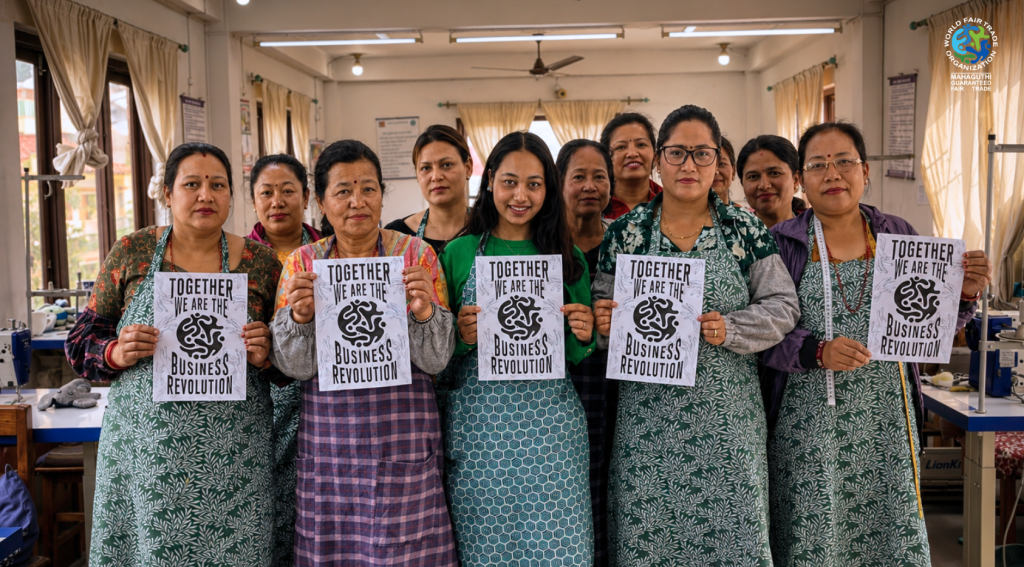

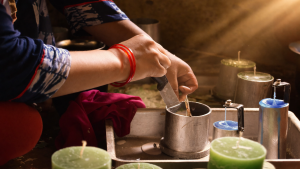


The birth of Mahaguthi Craft with Conscience started with yarn spinning and weaving. Mahaguthi empowers women by providing long term employment under fair, just and sustainable working conditions. It practices Fair Trade as its core principle that puts people first. We bring you “Kalpa” by Mahaguthi, the contemporary designs including clothing made mostly from hand loom to give you that authentic and rich texture yet satisfying the present day demand of the fashion world

Kalpa By Mahaguthi
- KALPA represents Mahaguthi’s persistency in promoting age old tradition of craftsmanship and providing livelihood to people specially women.
- KALPA meaning long life, sustainability and ritual represents Mahaguthi’s vision, mission and business model.
- KALPA represents Mahaguthi’s continuous work of empowering people specially women, differently able people and socially deprived community to improve their livings.
- KALPA represents a sustainable lifestyle brand of Mahaguthi that comprises fashion, living and giving.
More on Kalpa by Mahaguthi
Following fashion is thing of past, let us be the trendsetters! Shopping for fun is old school, shopping with cause is what outsmarts you from the rest. Your each purchase from Mahaguthi directly helps the people involved in every step of supply chain as 68% of the sales go back to the artisans of the products. Mahaguthi, being the founding member of Fair Trade Group Nepal (FTG Nepal), and member of World Fair Trade Organization Asia and Global practices, promotes and advocates Fair Trade at national, regional and international level. Fair Trade is a trading partnership based on dialogue, transparency and respect that seeks greater equity in international trade. It is a social movement whose stated goal is to help producers in developing countries achieve better trading conditions and to promote sustainability.
History has witnessed many weak and oppressed, needy are deprived people throughout time, and few men who chose to stand up and fight for their rights. Nepal has such a legend in its past the late Tulsi Mehar Shrestha.

Tulsi Mehar was born in a humble middle class Newar family on December 30th 1896 in Lalitpur District of Nepal. He was an only child who was deeply inspired by reading the book of Maharshi Dayanand intitled “The Light of Truth”.His self realizations about life and observation of self-discipline led him to understand the difficulties of the time when people were not allowed education or to express their views freely. Tulsi Mehar dared to speak up to society about the importance of self awareness and urged people to overcome ignorance and evil woes.
Speak publicly
He began to speak publicly against the prevalent religion of Hinduism, especially against the rigid caste system which led to the oppression of marginalized people, mostly women. His vision towards social reform and development emphasized women’s empowerment through education and income generation programs to make women economically self-reliant. The expression of his views caused an uproar in Nepali society, pushing Prime Minister Chandra Shumsher J. B. Rana to accuse Tulsi Mehar of being anti-national. He offered him a choice – life imprisonment or life-long exile. Tulsi Mehar chose to set out for India.
Search for truth
His search for truth, his strong will and dedication to work for the society brought him to work closely with Mahatma Gandhi of India. He stayed in various ashrams and dedicated himself wholeheartedly to learn spinning and weaving techniques. His time with Mahatma Gandhi gave him an opportunity to gain experience and insight to the liberation of underprivileged people and renewed his commitment and conviction to return to Nepal in 1923 to bring social change. Mahatma Gandhi wrote a letter to the Nepali Prime Minister to allow Tulsi Mehar to come back to Nepal and let him work for the sake of Nepalese people. The Rana Prime Minister gave him consent and Tulsi Mehar started a small project of spinning and weaving some seventy five years ago.
Settlement
Tulsi Mehar settled at Shankhamul Ghat on the bank of the sacred Bagmati River in Lalitpur District. There, he started the first textile industry in Nepal with a bundle of raw cotton donated by Gandhi, which he used as raw material for the spinning program. He established an institution named “Shree Tin Chandra Kamdhenu Charkha Pracharak Mahaguthi” in 1927 which was one of the first social services organizations at the time